how to draw a 3d apollo 13 spacecraft
 Apollo 16 LM Orion on the lunar surface, 1972 | |
| Manufacturer | Grumman |
|---|---|
| Designer | Thomas J. Kelly |
| Country of origin | United States |
| Operator | NASA |
| Applications | Crewed lunar landing |
| Specifications | |
| Launch mass |
|
| Dry out mass |
|
| Coiffure capacity | two |
| Volume | 235 cu ft (6.seven mthree) |
| Power | 28 5 DC, 115 V 400 Hz Air-conditioning |
| Batteries | 2 28–32-volt, 296 ampere hour silverish-zinc |
| Government | Lunar |
| Pattern life | 75 hours (Extended) |
| Dimensions | |
| Length | 23 ft ane in (7.04 one thousand) |
| Diameter | 13 ft x in (4.22 m) without landing gear |
| Width | 31 ft (ix.4 thou), landing gear deployed |
| Product | |
| Status | Retired |
| Congenital | xv |
| Launched | 10 |
| Operational | 10 |
| Failed | 0 |
| Lost | 0 |
| Maiden launch | Jan 22, 1968 |
| Last launch | December fourteen, 1972 |
| Last retirement | Dec 15, 1972 |
| Related spacecraft | |
| Flown with | Apollo command and service module |
 | |
| Configuration | |
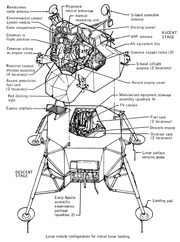 Apollo LM diagram | |
The Apollo Lunar Module, or but Lunar Module (LM ), originally designated the Lunar Excursion Module (LEM), was the Lunar lander spacecraft that was flown betwixt lunar orbit and the Moon's surface during the United States' Apollo program. It was the start crewed spacecraft to operate exclusively in the airless vacuum of infinite, and remains the only crewed vehicle to land anywhere beyond Earth.
Structurally and aerodynamically incapable of flight through Earth'south atmosphere, the two-stage lunar module was ferried to lunar orbit attached to the Apollo control and service module (CSM), nearly twice its mass. Its coiffure of ii flew the complete lunar module from lunar orbit to the Moon's surface. During takeoff, the spent descent stage was used as a launch pad for the ascension stage which then flew back to the control module, after which it was also discarded.
Overseen by Grumman, the LM'south development was plagued with problems that delayed its start uncrewed flying by well-nigh ten months and its first crewed flight past about three months. Still, the LM became the most reliable component of the Apollo–Saturn space vehicle.[1] The total cost of the LM for evolution and the units produced was $21.3 billion in 2022 dollars, adjusting from a nominal total of $two.2 billion[2] using the NASA New Start Aggrandizement Indices.[3] [ failed verification ]
10 lunar modules were launched into space. Of these, half dozen were landed by humans on the Moon from 1969 to 1972. The first two launched were examination flights in low Earth orbit—the first without a coiffure, the 2nd with one. Another was used by Apollo 10 for a dress rehearsal flight in low lunar orbit, without landing. One lunar module functioned equally a lifeboat for the coiffure of Apollo 13, providing life support and propulsion when their CSM was disabled by an oxygen tank explosion en route to the Moon, forcing the crew to abandon plans for a lunar landing.
The six landed descent stages remain at their landing sites; their corresponding ascent stages crashed into the Moon following use. One ascent stage (Apollo 10's Snoopy) was discarded in a heliocentric orbit after its descent stage was discarded in lunar orbit. The other three LMs were burned up in the Earth's atmosphere: the four stages of Apollo v and Apollo 9 each re-entered separately, while Apollo xiii's Aquarius re-entered consummate, post-obit emergency maneuvers.
Operational profile [edit]
At launch, the lunar module sat directly below the command and service module (CSM) with legs folded, within the Spacecraft-to-LM adapter (SLA) fastened to the S-IVB 3rd phase of the Saturn V rocket. In that location information technology remained through Globe parking orbit and the trans-lunar injection (TLI) rocket burn to send the craft toward the Moon.
Soon later TLI, the SLA opened; the CSM performed a maneuver whereby it separated, turned around, came back to dock with the lunar module, and extracted it from the Southward-IVB. During the flight to the Moon, the docking hatches were opened and the lunar module pilot entered the LM to power up temporarily and exam all systems except propulsion. The lunar module pilot performed the part of an engineering officer, monitoring the systems of both spacecraft.
Later on achieving a lunar parking orbit, the commander and LM pilot entered and powered up the LM, replaced the hatches and docking equipment, unfolded and locked its landing legs, and separated from the CSM, flight independently. The commander operated the flight controls and engine throttle, while the lunar module airplane pilot operated other spacecraft systems and kept the commander informed well-nigh systems status and navigational information. Afterward the command module pilot visually inspected the landing gear, the LM was withdrawn to a safe distance, then rotated until the descent engine was pointed forrad into the direction of travel. A xxx-second descent orbit insertion fire was performed to reduce speed and drib the LM'south perilune to inside about 50,000 feet (fifteen km) of the surface,[iv] about 260 nautical miles (480 km) uprange of the landing site.

As the craft approached perilune, the descent engine was started again to begin powered descent. During this time, the crew flew on their backs, depending on the computer to slow the craft'south forward and vertical velocity to near zero. Control was exercised with a combination of engine throttling and mental attitude thrusters, guided by the computer with the assistance of landing radar. During braking, the LM descended to about 10,000 feet (iii.0 km), then, in the final arroyo phase, downwardly to well-nigh 700 feet (210 m). During final approach, the vehicle pitched over to a virtually-vertical position, assuasive the crew to look forward and down to see the lunar surface for the first time.[5]
Astronauts flew Apollo spacecraft manually only during the lunar arroyo.[6] The last landing phase began nearly 2,000 feet (0.61 km) uprange of the targeted landing site. At this indicate, transmission command was enabled for the commander, who had enough propellant to hover for upwards to two minutes to survey where the computer was taking the arts and crafts and make any necessary corrections. If necessary, landing could have been aborted at about any fourth dimension by jettisoning the descent stage and firing the ascent engine to climb dorsum into orbit for an emergency render to the CSM. Finally, one or more of three 67.2-inch (1.71 k) probes extending from footpads on the legs of the lander touched the surface, activating the contact indicator light which signaled the commander to shut off the descent engine, allowing the LM to settle onto the surface. On touchdown, the probes would be aptitude every bit much as 180 degrees, or even break off. The original blueprint used the probes on all four legs, but starting with the starting time landing (LM-five on Apollo 11), the ane at the ladder was removed out of concern that the bent probe after landing might puncture an astronaut'south suit every bit he descended or stepped off the ladder.
The original extravehicular activity program, up through at least 1966, was for only one astronaut to leave the LM while the other remained inside "to maintain communications".[7] Communications were eventually accounted to be reliable enough to permit both coiffure members to walk on the surface, leaving the spacecraft to exist but remotely attended by Mission Command.
Beginning with Apollo 14, extra LM propellant was made available for the powered descent and landing, by using the CSM engine to achieve the 50,000-pes (xv km) perilune. After the spacecraft undocked, the CSM raised and circularized its orbit for the remainder of the mission.
When ready to leave the Moon, the LM's ascent engine fired, leaving the descent stage on the Moon'southward surface. After a few form correction burns, the LM rendezvoused with the CSM and docked to transfer the crew and rock samples. Having completed its job, the rise stage was separated. The Apollo 10 ascent stage engine was fired until its fuel was used upwards, sending information technology past the Moon into a heliocentric orbit.[8] [nine] The Apollo 11 ascent stage was left in lunar orbit to eventually crash; all subsequent rise stages (except for Apollo 13) were intentionally steered into the Moon to obtain readings from seismometers placed on the surface.
History [edit]
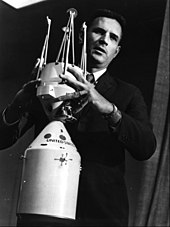
A 1962 model of the commencement LEM design, docked to the command and service module. The model is held by Joseph Shea, the key engineer backside the adoption of lunar orbit rendezvous mission logistics.
The Lunar Module (originally designated the Lunar Excursion Module, known by the acronym LEM) was designed later on NASA chose to reach the Moon via Lunar Orbit Rendezvous (LOR) instead of the directly rise or Earth Orbit Rendezvous (EOR) methods. Both direct ascent and EOR would take involved landing a much heavier, consummate Apollo spacecraft on the Moon. In one case the decision had been fabricated to go on using LOR, it became necessary to produce a separate craft capable of reaching the lunar surface and ascending back to lunar orbit.
Contract letting [edit]
In July 1962, eleven firms were invited to submit proposals for the LEM. Nine companies responded in September, answering twenty questions posed by the NASA RFP in a threescore-page limited technical proposal. Grumman was awarded the contract officially on November seven, 1962.[10] Grumman had begun lunar orbit rendezvous studies in the late 1950s and once again in 1961. The contract toll was expected to exist around $350 million.[eleven] In that location were initially four major subcontractors: Bong Aerosystems (ascent engine), Hamilton Standard (environmental control systems), Marquardt (reaction control system) and Rocketdyne (descent engine).[12]
The Primary Guidance, Navigation and Command System (PGNCS) was developed past the MIT Instrumentation Laboratory; the Apollo Guidance Computer was manufactured by Raytheon (a similar guidance arrangement was used in the command module). A backup navigation tool, the Abort Guidance System (AGS), was adult by TRW.
Pattern stage [edit]

This 1963 model depicts the 2nd LEM design, which gave rise to breezy references as "the bug".
The Apollo Lunar Module was chiefly designed by Grumman aerospace engineer Thomas J. Kelly.[13] The first LEM blueprint looked like a smaller version of the Apollo control and service module (a cone-shaped cabin atop a cylindrical propulsion section) with folding legs. The 2nd design invoked the idea of a helicopter cockpit with big curved windows and seats, to improve the astronauts' visibility for hover and landing. This besides included a 2d, frontwards docking port, allowing the LEM crew to take an agile role in docking with the CSM.
As the program continued, there were numerous redesigns to save weight, improve rubber, and fix problems. First to go were the heavy cockpit windows and the seats; the astronauts would stand while flight the LEM, supported by a cable and pulley system, with smaller triangular windows giving them sufficient visibility of the landing site. Later, the redundant forward docking port was removed, which meant the Command Pilot gave upwardly active control of the docking to the Control Module Pilot; he could still meet the approaching CSM through a minor overhead window. Egress while wearing beefy extra-vehicular activity spacesuits was eased by a simpler forrad hatch (32 in × 32 in or 810 mm × 810 mm).
The configuration was frozen in Apr 1963, when the ascent and descent engine designs were decided. In addition to Rocketdyne, a parallel plan for the descent engine[14] was ordered from Infinite Technology Laboratories (TRW) in July 1963, and by January 1965 the Rocketdyne contract was canceled.
Power was initially to be produced by fuel cells built by Pratt and Whitney like to the CSM, but in March 1965 these were discarded in favor of an all-battery pattern.[15]
The initial design had three landing legs, the lightest possible configuration. Just as any particular leg would accept to comport the weight of the vehicle if it landed at a significant angle, this was also the least stable configuration if ane of the legs were damaged during landing. The next landing gear pattern iteration had five legs and was the most stable configuration for landing on an unknown terrain. That configuration, all the same, was too heavy and the designers compromised on 4 landing legs.[16]
In June 1966, the name was changed to Lunar Module (LM), eliminating the word circuit.[17] [18] According to George Low, Manager of the Apollo Spacecraft Program Part, this was considering NASA was afraid that the word circuit might lend a frivolous notation to Apollo.[19] Despite the name change from "LEM" to "LM", the pronunciation of the abbreviation () did not change.
Astronaut training [edit]
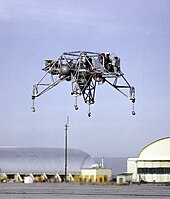
Comparing landing on the Moon to "a hovering performance", Gus Grissom said in 1963 that although most early astronauts were fighter pilots, "now we're wondering if the pilot making this first moon landing shouldn't be a highly experienced helicopter pilot".[twenty] To let astronauts to learn lunar landing techniques, NASA contracted Bong Aerosystems in 1964 to build the Lunar Landing Enquiry Vehicle (LLRV), which used a gimbal-mounted vertical jet engine to counter five-sixths of its weight to simulate the Moon's gravity, in improver to its own hydrogen peroxide thrusters to simulate the LM's descent engine and mental attitude control. Successful testing of two LLRV prototypes at the Dryden Flight Research Eye led in 1966 to three product Lunar Landing Training Vehicles (LLTV) which forth with the LLRV's were used to railroad train the astronauts at the Houston Manned Spacecraft Center. This aircraft proved fairly dangerous to fly, as 3 of the 5 were destroyed in crashes. It was equipped with a rocket-powered ejection seat, so in each case the pilot survived, including the starting time man to walk on the Moon, Neil Armstrong.[21]
Development flights [edit]

The Apollo 6 Lunar Module Exam Article (LTA-2R) shortly before being mated with the SLA
LM-ane was congenital to make the first uncrewed flight for propulsion systems testing, launched into low Earth orbit atop a Saturn IB. This was originally planned for April 1967, to be followed by the get-go crewed flight afterwards that year. But the LM'south development problems had been underestimated, and LM-i'south flying was delayed until Jan 22, 1968, as Apollo v. At that time, LM-two was held in reserve in case the LM-1 flight failed, which did not happen.
LM-3 at present became the first crewed LM, again to be flown in depression World orbit to test all the systems, and exercise the separation, rendezvous, and docking planned for Apollo viii in December 1968. But over again, last-minute problems delayed its flight until Apollo 9 on March 3, 1969. A 2nd, higher Earth orbit crewed practice flight had been planned to follow LM-3, only this was canceled to go on the plan timeline on track.
Apollo x launched on May xviii, 1969, using LM-4 for a "dress rehearsal" for the lunar landing, practicing all phases of the mission except powered descent initiation through takeoff. The LM descended to 47,400 feet (9.0 mi; xiv.4 km) to a higher place the lunar surface, and then jettisoned the descent stage and used its ascent engine to return to the CSM.[22]
Production flights [edit]
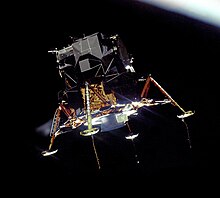
The first crewed lunar landing occurred on July xx, 1969, in the Apollo 11 LM-5 Hawkeye. Iv days later, the Apollo 11 crew in the command module Columbia splashed down in the Pacific Ocean, completing President John F. Kennedy's goal: "...before this decade is out, of landing a man on the Moon and returning him safely to the Earth".
This was followed by landings past Apollo 12 (LM-6 Intrepid) and Apollo xiv (LM-8 Antares). In April 1970, the Apollo 13 LM-7 Aquarius played an unexpected role in saving the lives of the 3 astronauts afterwards an oxygen tank in the service module ruptured, disabling the CSM. Aquarius served as a "lifeboat" for the astronauts during their return to Earth. Its descent stage engine[14] was used to replace the bedridden CSM Service Propulsion System engine, and its batteries supplied power for the trip home and recharged the Command Module's batteries disquisitional for reentry. The astronauts splashed downwards safely on Apr 17, 1970. The LM'south systems, designed to support two astronauts for 45 hours (including twice depressurization and repressurization causing loss of oxygen supply), actually stretched to support iii astronauts for xc hours (without depressurization and repressurization and loss of oxygen supply).
Hover times were maximized on the last four landing missions by using the Service Module engine to perform the initial descent orbit insertion fire 22 hours before the LM separated from the CSM, a practice begun on Apollo xiv. This meant that the complete spacecraft, including the CSM, orbited the Moon with a ix.1-nautical-mile (16.ix km) perilune, enabling the LM to begin its powered descent from that altitude with a full load of descent phase propellant, leaving more reserve propellant for the final approach. The CSM would and then raise its perilune dorsum to the normal 60 nautical miles (110 km).[23]
Extended J-course missions [edit]

Decreased clearance led to buckling of the extended descent engine nozzle on the landing of Apollo xv
The extended lunar module (ELM) used on the final three "J-class missions" — Apollo 15, sixteen, and 17 — was upgraded to state larger payloads and stay longer on the lunar surface. The descent engine thrust was increased past the add-on of a 10-inch (250 mm) extension to the engine bell, and the descent propellant tanks were enlarged. A waste storage tank was added to the descent phase, with plumbing from the ascent stage. These upgrades immune stays of upward to 75 hours on the Moon.
The Lunar Roving Vehicle was folded up and carried in Quadrant ane of the descent stage. It was deployed by the astronauts after landing, allowing them to explore large areas and return a greater variety of lunar samples.
Specifications [edit]

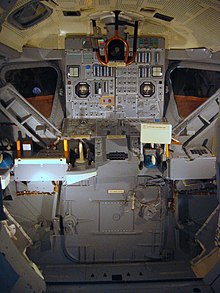

Astronaut residuum (sleeping) accommodation

Lunar module cutaway analogy
Weights given here are an average for the original pre-ELM spec vehicles. For specific weights for each mission, run into the private mission articles.
Rising stage [edit]
The ascension phase contained the crew cabin with instrument panels and flight controls. It contained its own Rise Propulsion Organization (APS) engine and two hypergolic propellant tanks for return to lunar orbit and rendezvous with the Apollo command and service module. Information technology also contained a Reaction Control System (RCS) for mental attitude and translation command, which consisted of sixteen hypergolic thrusters similar to those used on the Service Module, mounted in 4 quads, with their ain propellant supply. A forward extravehicular activeness hatch provided access to and from the lunar surface, while an overhead hatch and docking port provided access to and from the Control Module.
Internal equipment included an environmental control (life back up) system; a VHF communications system with two antennas for advice with the Control Module; a unified S-ring system and steerable parabolic dish antenna for communication with Earth; an extravehicular activity antenna resembling a miniature parasol which relayed communications from antennas on the astronauts' Portable Life Support Systems through the LM; primary (PGNCS) and fill-in (AGS) guidance and navigation systems; an Alignment Optical Telescope for visually determining the spacecraft orientation; rendezvous radar with its own steerable dish antenna; and a system for active thermal command. Electrical storage batteries, cooling h2o, and breathing oxygen were stored in amounts sufficient for a lunar surface stay of 48 hours initially, extended to 75 hours for the afterward missions.
During balance periods while parked on the Moon, the crew would sleep on hammocks slung crosswise in the cabin.
The return payload included the lunar stone and soil samples collected by the coiffure (every bit much every bit 238 pounds (108 kg) on Apollo 17), plus their exposed photographic film.
- Crew: 2
- Crew cabin volume: 235 cu ft (six.vii 10003)
- Habitable book: 160 cu ft (four.5 m3)
- Crew compartment height: 7 ft 8 in (ii.34 m)
- Coiffure compartment depth: iii ft six in (1.07 m)
- Top: 9 ft 3.5 in (2.832 m)
- Width: 14 ft 1 in (4.29 m)
- Depth: thirteen ft three in (4.04 m)
- Mass, dry: 4,740 lb (2,150 kg)
- Mass, gross: ten,300 lb (4,700 kg)
- Atmosphere: 100% oxygen at 4.8 psi (33 kPa)
- H2o: two 42.five lb (19.iii kg) storage tanks
- Coolant: 25 pounds (11 kg) of ethylene glycol / water solution
- Thermal Control: 1 active water-water ice sublimator
- RCS propellant mass: 633 lb (287 kg)
- RCS thrusters: xvi x 100 lbf (440 N) in iv quads
- RCS propellants: Aerozine 50 fuel / Dinitrogen tetroxide (N2O4) oxidizer
- RCS specific impulse: 290 s (2.eight km/s)
- APS propellant mass: five,187 lb (2,353 kg) stored in 2 36-cubic-pes (1.02 chiliadthree) propellant tanks
- APS engine: Bell Aerospace LM Ascent Engine (LMAE) and Rocketdyne LMAE Injectors
- APS thrust: 3,500 lbf (16,000 Northward)
- APS propellants: Aerozine fifty fuel / Dinitrogen Tetroxide oxidizer
- APS pressurant: two 6.four lb (two.nine kg) helium tanks at iii,000 pounds per square inch (21 MPa)
- APS specific impulse: 311 s (3.05 km/s)
- APS delta-Five: seven,280 ft/s (2,220 m/s)
- Thrust-to-weight ratio at liftoff: 2.124 (in lunar gravity)
- Batteries: two 28–32 volt, 296 ampere hour Silvery-zinc batteries; 125 lb (57 kg) each
- Power: 28 Five DC, 115 V 400 Hz Air-conditioning
Descent stage [edit]

The descent stage's primary job was to support a powered landing and surface extravehicular activity. When the excursion was over, information technology served as the launch pad for the ascent stage. Its octagonal shape was supported by four folding landing gear legs, and contained a throttleable Descent Propulsion Organization (DPS) engine with four hypergolic propellant tanks. A continuous-moving ridge Doppler radar antenna was mounted past the engine heat shield on the bottom surface, to send altitude and rate of descent data to the guidance arrangement and pilot display during the landing. Well-nigh all external surfaces, except for the top, platform, ladder, descent engine and heat shield, were covered in bister, nighttime (reddish) amber, black, silver, and yellowish aluminized Kapton foil blankets for thermal insulation. The number one (front) landing leg had an attached platform (informally known as the "porch") in front of the ascent phase'south extravehicular activity hatch and a ladder, which the astronauts used to arise and descend between the cabin to the surface. The footpad of each landing leg incorporated a 67-inch-long (ane.7 m) surface contact sensor probe, which signaled the commander to switch off the descent engine. (The probe was omitted from the number ane leg of every landing mission, to avoid a suit-puncture hazard to the astronauts, every bit the probes tended to intermission off and protrude upwards from the surface.)
Equipment for the lunar exploration was carried in the Modular Equipment Stowage Assembly (MESA), a drawer mounted on a hinged panel dropping out of the lefthand forwards compartment. Likewise the astronaut's surface excavation tools and sample collection boxes, the MESA contained a television camera with a tripod; equally the commander opened the MESA by pulling on a lanyard while descending the ladder, the camera was automatically activated to send the first pictures of the astronauts on the surface back to Earth. A U.s.a. flag for the astronauts to cock on the surface was carried in a container mounted on the ladder of each landing mission.
The Early Apollo Surface Experiments Package (later the Apollo Lunar Surface Experiments Parcel), was carried in the reverse compartment backside the LM. An external compartment on the correct front console carried a deployable S-band antenna which, when opened looked like an inverted umbrella on a tripod. This was non used on the first landing due to fourth dimension constraints, and the fact that acceptable communications were being received using the LM's South-band antenna, simply was used on Apollo 12 and 14. A hand-pulled Modular Equipment Transporter (MET), similar in advent to a golf game cart, was carried on Apollo 13 and xiv to facilitate carrying the tools and samples on extended moonwalks. On the extended missions (Apollo xv and later), the antenna and TV camera were mounted on the Lunar Roving Vehicle, which was carried folded up and mounted on an external panel. Compartments as well contained replacement Portable Life Support System (PLSS) batteries and extra lithium hydroxide canisters on the extended missions.
- Superlative: 10 ft 7.2 in (iii.231 grand) (plus 5 ft 7.two in (i.707 m) landing probes)
- Width/depth, minus landing gear: thirteen ft 10 in (4.22 yard)
- Width/depth, landing gear extended: 31.0 ft (9.four g)
- Mass including propellant: 22,783 lb (x,334 kg)
- Water: one 151 kg (333 lb) storage tank
- DPS propellant mass: 18,000 lb (8,200 kg) stored in four 67.3-cubic-human foot (1.906 grandthree) propellant tanks
- DPS engine: TRW LM descent engine (LMDE)[24] [xiv]
- DPS thrust: ten,125 lbf (45,040 N), throttleable between 10% and threescore% of full thrust
- DPS propellants: Aerozine 50 fuel / nitrogen tetroxide oxidizer
- DPS pressurant: 1 49-pound (22 kg) supercritical helium tank at ane,555 psi (10.72 MPa)
- DPS specific impulse: 311 s (3,050 N⋅s/kg)
- DPS delta-V: 8,100 ft/s (2,500 1000/southward)
- Batteries: four (Apollo 9-14) or 5 (Apollo xv-17) 28–32 Five, 415 A⋅h silver-zinc batteries; 135 lb (61 kg) each
Lunar modules produced [edit]
| Serial number | Name | Apply | Launch date | Location | Paradigm |
|---|---|---|---|---|---|
| LTA-ane | Unflown | Cradle of Aviation Museum (Long Island, NY)[25] |  | ||
| LTA-2R | Apollo 6 | Apr 4, 1968 | Re-entered Globe's atmosphere |  | |
| LTA-3A | Unflown | Kansas Cosmosphere and Space Center[25] |  | ||
| LTA-3DR | Unflown descent stage | Franklin Institute[25] |  | ||
| LTA-5D | Unflown | NASA White Sands Test Facility[25] | |||
| LTA-8A[25] | Lunar Module Test Article no.8 | Thermal-vacuum tests | Ground tests in 1968 | Space Centre Houston[25] | |
| LTA-10R | Apollo 4 | Nov 9, 1967 | Re-entered Earth'south atmosphere[25] | ||
| MSC-16 | Not-flying rise stage | Museum of Science and Manufacture (Chicago)[25] |  | ||
| TM-5 | Non-flight | Museum of Life and Science (Durham, NC)[25] |  | ||
| PA-1 | Unflown | White Sands Examination Facility[25] | |||
| LM-ane | Apollo 5 | January 22, 1968 | Re-entered Earth'south temper |  | |
| LM-2 | Intended for 2d uncrewed flight, used instead for basis testing. Landing gear added for drop testing. Lacks Alignment Optical Telescope and flying calculator[26] | National Air and Infinite Museum (Washington, D.C.) |  | ||
| LM-3 | Spider | Apollo 9 | March 3, 1969 | Descent and ascent stages reentered Globe's atmosphere separately | 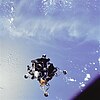 |
| LM-4 | Snoopy | Apollo 10 | May xviii, 1969 | Descent stage may have striking the Moon, ascent stage in heliocentric orbit. Snoopy is the simply flown LM ascension phase known to have survived intact (possibly asteroid 2022 AV2[27]). |  |
| LM-5 | Eagle | Apollo eleven | July 16, 1969 | Descent stage on lunar surface in Sea of Quiet, ascent stage left in lunar orbit (could be still orbiting the moon [28]) |  |
| LM-6 | Intrepid | Apollo 12 | November 14, 1969 | Descent stage on lunar surface at Ocean of Storms, ascent phase deliberately crashed into Moon |  |
| LM-7 | Aquarius | Apollo 13 | Apr 11, 1970 | Re-entered World'due south atmosphere |  |
| LM-viii | Antares | Apollo 14 | January 31, 1971 | Descent stage on lunar surface at Fra Mauro, rising phase deliberately crashed into Moon | 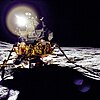 |
| LM-9 | Non flown, intended equally Apollo 15, final H-grade mission | On display at the Kennedy Space Center (Apollo/Saturn Five Center) | 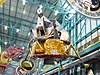 | ||
| LM-10 | Falcon | Apollo 15, first ELM | July 26, 1971 | Descent stage on lunar surface at Hadley–Apennine, ascent stage deliberately crashed into Moon |  |
| LM-eleven | Orion | Apollo 16 | April 16, 1972 | Descent stage on lunar surface at Descartes Highlands, rising phase left in lunar orbit, crashed on Moon | 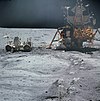 |
| LM-12 | Challenger | Apollo 17 | December 7, 1972 | Descent phase on lunar surface at Taurus-Littrow, ascent stage deliberately crashed into Moon |  |
| LM-13 | Non flown, intended every bit Apollo nineteen[29] [30] | Partially completed by Grumman, restored and on brandish at Cradle of Aviation Museum (Long Island, NY). Also used during 1998 miniseries From the Earth to the Moon. |  | ||
| LM-14 | Not flown, intended every bit Apollo xx[31] | Incomplete, virtually probable scrapped[32] | | ||
| LM-15 | Not flown, intended for modification into Apollo Telescope Mount[33] [34] | Incomplete,[32] scrapped[35] | |||
| * For the location of LMs left on the Lunar surface, see list of human-made objects on the Moon. | |||||
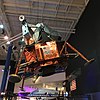
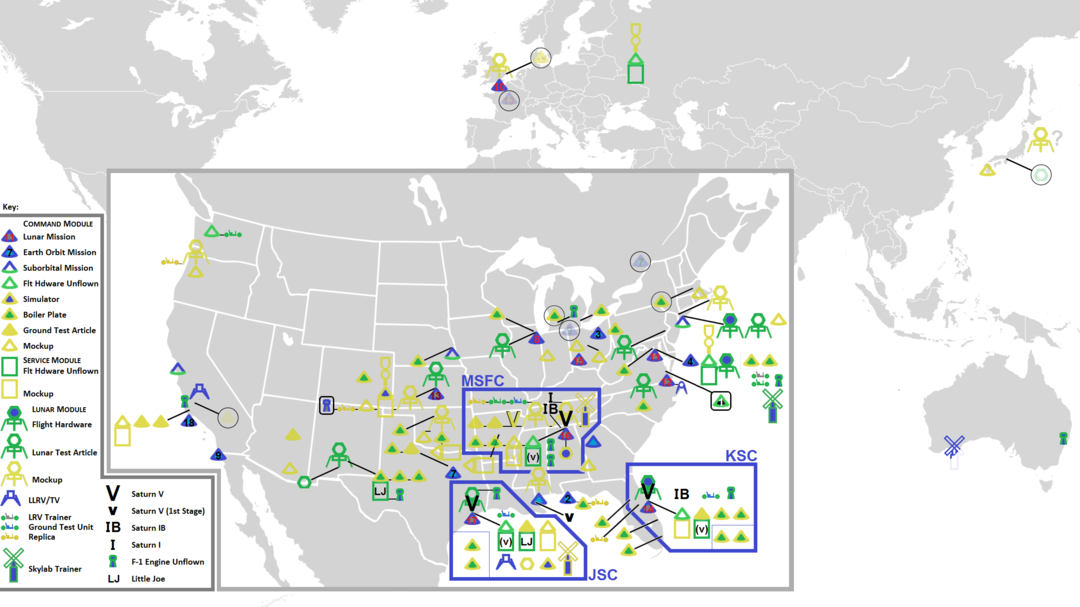
World map showing locations of Apollo Lunar Modules (along with other hardware).
Proposed derivatives [edit]
Apollo Telescope Mountain [edit]

Original proposed "wet workshop" Skylab with the Apollo Telescope Mount
One proposed Apollo application was an orbital solar telescope constructed from a surplus LM with its descent engine replaced with a telescope controlled from the ascent phase cabin, the landing legs removed and iv "windmill" solar panels extending from the descent stage quadrants. This would have been launched on an uncrewed Saturn 1B, and docked with a crewed command and service module, named the Apollo Telescope Mission (ATM).
This idea was later transferred to the original wet workshop design for the Skylab orbital workshop and renamed the Apollo Telescope Mount to be docked on a side port of the workshop's multiple docking adapter (MDA). When Skylab inverse to a "dry out workshop" pattern pre-fabricated on the basis and launched on a Saturn V, the telescope was mounted on a hinged arm and controlled from inside the MDA. Only the octagonal shape of the telescope container, solar panels and the Apollo Telescope Mount name were kept, though there was no longer any association with the LM.
LM Truck [edit]
The Apollo LM Truck (also known as Lunar Payload Module) was a stand up-alone LM descent stage intended to deliver up to 11,000 pounds (5.0 t) of payload to the Moon for an uncrewed landing. This technique was intended to deliver equipment and supplies to a permanent crewed lunar base. As originally proposed, it would exist launched on a Saturn Five with a full Apollo coiffure to accompany information technology to lunar orbit and guide it to a landing adjacent to the base; and then the base coiffure would unload the "truck" while the orbiting crew returned to Earth.[36] In later AAP plans, the LPM would accept been delivered past an uncrewed lunar ferry vehicle.
Depiction in movie and television receiver [edit]
The 1995 Ron Howard flick Apollo 13, a dramatization of that mission starring Tom Hanks, Kevin Bacon, and Neb Paxton, was filmed using realistic spacecraft interior reconstructions of the Aquarius and the Command Module Odyssey.
The development and construction of the lunar module is dramatized in the 1998 miniseries From the Globe to the Moon episode entitled "Spider". This is in reference to LM-3, used on Apollo 9, which the crew named Spider afterwards its spidery appearance. The unused LM-13 stood in during the teleplay to depict LM-iii and LM-5, Hawkeye, used by Apollo xi.
Apollo xi Lunar Module Hawkeye is depicted in the 2022 film Offset Homo, a biopic of Neil Armstrong.
Media [edit]
-
David Scott lands Apollo 15 Lunar Module Falcon on the Moon on July 30, 1971, seen from the perspective of the Lunar Module Pilot. Starts at approximately 5000 feet from the surface.
-
Apollo 15 Lunar Module Falcon lifts off from the Moon, August ii, 1971. View from TV camera on the Lunar Roving Vehicle.
-
Apollo 15 Lunar Module liftoff. View from inside Falcon.
-
Apollo 17 Lunar Module Challenger liftoffs from the Moon on December 14, 1972. View from Goggle box camera on the Lunar Roving Vehicle.
-

Equipment location plans (1 of 2)
-
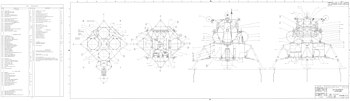
Equipment location plans (2 of two)
-
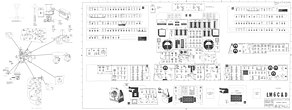
Controls plans
-
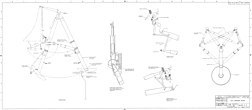
Landing Gear plans
See also [edit]
- List of crewed lunar lander designs
- LK (spacecraft)
- Lunar Escape Systems
- Rolls Royce Thrust Measuring Rig, the 'Flying Beadstead'
References [edit]
- ^ Moon Race: The History of Apollo DVD, Columbia River Amusement (Portland, Oregon, 2007)
- ^ Orloff, Richard (1996). Apollo past the Numbers (PDF). National Aeronautics and Space Administration. p. 22. Archived (PDF) from the original on 2016-02-22. Retrieved 2016-05-23 .
- ^ "NASA New First Inflation Indices". National Aeronautics and Space Administration. Archived from the original on June 24, 2016. Retrieved May 23, 2016.
- ^ "Apollo 11 Lunar Orbit Stage". Archived from the original on 2017-12-26. Retrieved 2017-07-12 .
- ^ Gatland, Kenneth (1976). Manned Spacecraft, 2nd Revision. New York: Macmillan Publishing Co. pp. 194–196. ISBN0-02-542820-ix.
- ^ Agle, D.C. (September 1998). "Flying the Gusmobile". Air & Space. Archived from the original on 2020-04-03. Retrieved 2018-12-15 .
- ^ Landing on the Moon Archived 2021-04-15 at the Wayback Motorcar, 1966 episode of MIT's Scientific discipline Reporter (posted to YouTube by MIT on Jan 20, 2016)
Quote:
"While one astronaut explores the area around the LEM, the second remains inside to maintain communications." - ^ Ryba, Jeanne (ed.). "Apollo 10". NASA. Archived from the original on July 23, 2013. Retrieved June 26, 2013.
- ^ "Electric current locations of the Apollo Command Module Capsules (and Lunar Module crash sites)". Apollo: Where are they now?. NASA. Archived from the original on 17 July 2011. Retrieved 27 December 2014.
- ^ Teitel, Amy Shira (May 31, 2019). "Lunar Module: How do you country on the Moon?". Astronomy.com . Retrieved 2021-09-29 .
- ^ "Aerospace: Grumman in Orbit". Time. 1962-xi-16. ISSN 0040-781X. Retrieved 2021-09-29 .
- ^ Courtney Thousand. Brooks; James 1000. Grimwood; Loyd Southward. Swenson (September 20, 2007). "Chariots for Apollo: A History of Manned Lunar Spacecraft; Engines, Big and Small". Archived from the original on March 1, 2012. Retrieved June vii, 2012.
- ^ Leary, Warren East. (27 March 2002). "T. J. Kelly, 72, Dies; Father of Lunar Module". The New York Times. Archived from the original on 23 June 2017. Retrieved xviii February 2017.
- ^ a b c Remembering the Giants - Apollo Rocket Propulsion Evolution - NASA. NASA. pp. 73–86.
- ^ "LM Electrical". Encyclopedia Astronautica. Archived from the original on 2010-02-01.
- ^ "LM Landing Gear". Encyclopedia Astronautica. Archived from the original on 2010-02-01.
- ^ "SP-4402 Origins of NASA Names". NASA History. NASA. Archived from the original on December 4, 2016. Retrieved January xvi, 2015.
- ^ Scheer, Julian W. (Assistant Administrator for Public Affairs, NASA). Memorandum from Project Designation Commission, June 9, 1966.
- ^ Cortright, Edgar M. (1975). Apollo expeditions to the moon . Scientific and Technical Information Role, National Aeronautics and Space Administration. NASA.gov ch-four-2 Archived 2021-04-28 at the Wayback Auto.
- ^ Grissom, Gus (Feb 1963). "The MATS Flyer Interviews Major Gus Grissom". The MATS Flyer (Interview). Interviewed by John P. Richmond Jr. Military Air Transport Service, United states of america Air Strength. pp. 4–vii. Archived from the original on 2020-07-26. Retrieved 2020-06-28 .
- ^ "LLRV Monograph". Archived from the original on 2017-12-25. Retrieved 2017-07-12 .
- ^ Courtney Thou. Brooks; James M. Grimwood; Loyd S. Swenson (1979). "Chapter 12 Part seven". Chariots for Apollo: A History of Manned Lunar Spacecraft. NASA. ISBN0-486-46756-2. Archived from the original on 9 Feb 2008. Retrieved 2008-01-29 .
- ^ McDivitt, James A. (May 1971), "6. Trajectory", Apollo 14 Mission Report, NASA, archived from the original on Baronial 5, 2011, retrieved September 24, 2012
- ^ "TR-201 for Delta rocket second stage derived from LMDE". 1972. Archived from the original on 2008-07-06.
- ^ a b c d e f thousand h i j "Archived copy". Archived from the original on 2018-04-09. Retrieved 2018-04-09 .
{{cite web}}: CS1 maint: archived re-create as title (link) - ^ Maksel, Rebecca, What'due south real and what's not? Air & Space, June/July 2013, pp. 20-21
- ^ "Astronomers Might Have Establish Apollo 10's "Snoopy" Module". 14 June 2019. Archived from the original on 2021-05-19. Retrieved 2021-09-fourteen .
- ^ "New Evidence Suggests Apollo eleven's Lunar Ascent Module Could Notwithstanding exist Orbiting the Moon". Archived from the original on 2021-08-22. Retrieved 2021-08-22 .
- ^ "Grumman Lunar Module LM-xiii at the Cradle of Aviation Museum". www.cradleofaviation.org. Archived from the original on 2020-06-20. Retrieved 2020-06-30 .
- ^ 1971 NASA Authorization: Hearings, Xc-commencement Congress, Second Session, on H.R. 15695 (superseded by H.R. 16516) U.s.. Congress. House. Committee on Science and Astronautics. U.S. Government Printing Office. 1970. p. 887. Archived from the original on 2020-06-30. Retrieved 2020-06-thirty .
- ^ Us. Congress. House. Committee on Science and Astronautics 1970, p. 834 https://books.google.com/books?id=R79GAQAAMAAJ&pg=834. sfn mistake: no target: CITEREFUnited_States._Congress._House._Committee_on_Science_and_Astronautics1970 (help)
- ^ a b Mosher, Dave (16 October 2019). "NASA isn't sure what happened to 1 of its final Apollo moon landers. The truth is probably depressing". Business Insider. Archived from the original on 3 July 2020. Retrieved 29 June 2020.
- ^ 1970 NASA Authorisation: Hearings, Ninety-outset Congress, First Session, on H.R. 4046, H.R. 10251 (superseded by H.R. 11271) Us. Congress. House. Committee on Scientific discipline and Astronautics. U.Due south. Regime Press Office. 1969. pp. 1127–1128. Archived from the original on 2020-07-26. Retrieved 2020-06-30 .
- ^ United States. Congress. House. Commission on Scientific discipline and Astronautics 1969, p. 1021 https://books.google.com/books?id=J8ZGAQAAMAAJ&pg=1021. sfn fault: no target: CITEREFUnited_States._Congress._House._Committee_on_Science_and_Astronautics1969 (help)
- ^ "Location of Apollo Lunar Modules". Smithsonian National Air and Space Museum. Archived from the original on 9 September 2018. Retrieved 29 June 2020.
- ^ Apollo LM Truck on Mark Wade's Encyclopedia Astronautica Archived 2005-12-15 at the Wayback Motorcar – Description of adapted LM descent stage for the uncrewed ship of cargo to a permanent lunar base.
Farther reading [edit]
- Kelly, Thomas J. (2001). Moon Lander: How We Developed the Apollo Lunar Module (Smithsonian History of Aviation and Spaceflight Series). Smithsonian Institution Press. ISBN i-56098-998-X.
- Baker, David (1981). The History of Manned Space Flying. Crown Publishers. ISBN 0-517-54377-X
- Brooks, Courtney J., Grimwood, James Thou. and Swenson, Loyd S. Jr (1979) Chariots for Apollo: A History of Manned Lunar Spacecraft NASA SP-4205.
- Haeuplik-Meusburger S. (2011). Compages for Astronauts. An Activeness-based Arroyo. Springer. [1] ISBN 978-3-7091-0666-2
- Pellegrino, Charles R. and Stoff, Joshua. (1985) Chariots for Apollo: The Untold Story Backside the Race to the Moon. Atheneum. ISBN 0-689-11559-eight (This is non the NASA history serial book of the same base title, in a higher place, but a totally unrelated piece of work.)
- Sullivan, Scott P. (2004) Virtual LM: A Pictorial Essay of the Technology and Construction of the Apollo Lunar Module. Apogee Books. ISBN 1-894959-14-0
- Stoff, Joshua. (2004) Edifice Moonships: The Grumman Lunar Module. Arcadia Publishing. ISBN 0-7385-3586-9
External links [edit]
- NASA Lunar Module Documentation Lunar Surface Periodical
- Google Moon overview of Apollo landing sites
- NASA itemize: Apollo 14 Lunar Module
- Demonstration of the Lunar Circuit Module and explanation of its systems (1966, Thomas Kelly at Grumman found on Long Island, episode of Science Reporter, MIT motion picture posted to YouTube)
- Space/Arts and crafts Assembly & Test Remembered – A site "dedicated to the men and women that designed, congenital and tested the Lunar Module at Grumman Aerospace Corporation, Bethpage, New York"
- Nosotros Called It 'The Problems', Past D.C. Agle, Air & Space Magazine, September 1, 2001 - Overview of LM descent
- Apollo xi LM Structures handout for LM-v (PDF) – Training document given to astronauts which illustrates all discrete LM structures
- Apollo Operations Handbook, Lunar Module (LM ten and Subsequent), Book Ane. Subsystems Data (PDF) Manufacturers Handbook covering the systems of the LM.
- Apollo Operations Handbook, Lunar Module (LM 11 and Subsequent), Book Two. Operational Procedures Manufacturers Handbook covering the procedures used to wing the LM.
- Apollo 15 LM Activation Checklist for LM-10 – Checklist detailing how to prepare the LM for activation and flight during a mission
- Lunar module launch video
Games [edit]
- Perilune 3D Procedural Lunar Lander Simulation
- Lander On-line second Lunar Module Landing Simulation Game
- Like shooting fish in a barrel Lander 3D Lunar Module Landing Simulation Game
Source: https://en.wikipedia.org/wiki/Apollo_Lunar_Module
0 Response to "how to draw a 3d apollo 13 spacecraft"
Publicar un comentario